



Zone 1 vs Zone 2 ATEX PTZ Cameras: 2026 Compliance Guide for Specifiers
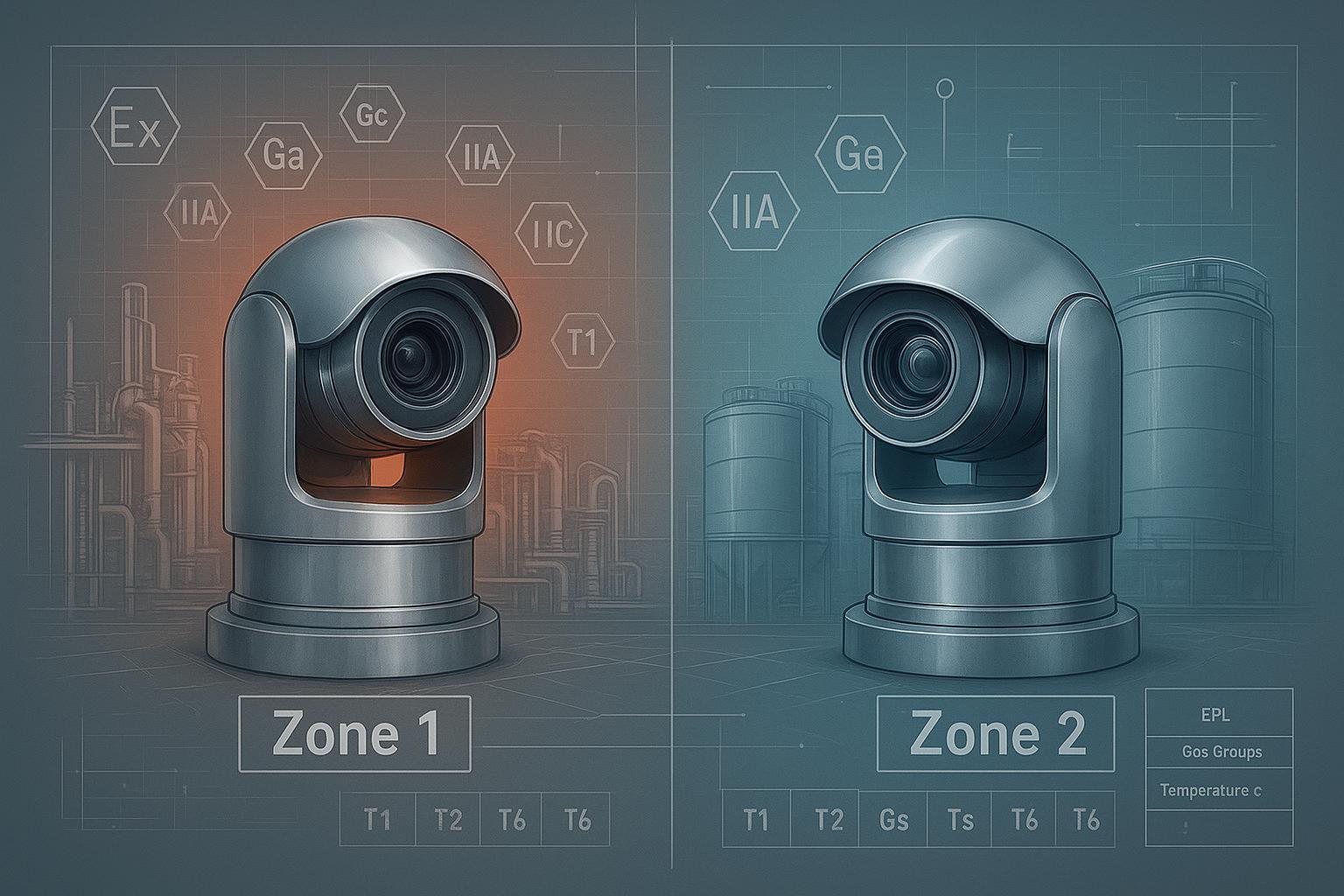
If an explosive gas atmosphere is likely during normal operation (intermittent but expected), specify Zone 1 (EPL Gb) PTZ equipment. If it is unlikely and only short‑lived during abnormal conditions, Zone 2 (EPL Gc) may be acceptable. In both cases, verify gas/dust group fit (IIA/IIB/IIC, IIIA/IIIB/IIIC), temperature class vs AIT, and installation per IEC/EN 60079-14. According to the UK regulator’s summaries, Zones 1 and 2 differ by the likelihood and duration of the explosive atmosphere, which drives the minimum EPL/Category you must choose as equipment—see the UK regulator’s hazardous area classification overview and ATEX equipment guidance for baseline definitions.
Quick comparison — Zone 1 vs Zone 2 ATEX
The phrase “Zone 1 vs Zone 2 ATEX” appears in spec sheets and RFQs, but the practical differences hinge on risk likelihood (normal vs abnormal) and the minimum Equipment Protection Level (EPL) required. Keep in mind that higher-rated Zone 1 (Gb) equipment is generally permissible for Zone 2 locations when all certificate conditions are met.
| Attribute | Zone 1 (Gas/Vapor) | Zone 2 (Gas/Vapor) |
| Hazard likelihood | Likely during normal operation (occasional presence) | Unlikely in normal operation; if present, brief |
| Minimum EPL / ATEX Category | Gb / Category 2G | Gc / Category 3G |
| Typical protection concepts | Ex d, Ex e, Ex p | Ex nA/nR (legacy), Gc variants of other concepts |
| Common PTZ deployments | Process units, pump seals, loading racks | Well-ventilated tank farms, utility areas |
| Interchangeability | Zone 1 (Gb) equipment may be used in Zone 2 if all conditions are satisfied | Zone 2-only equipment must not be used in Zone 1 |
What actually differs in practice
Beyond the headline “Zone 1 vs Zone 2 ATEX” label, specifiers must match gas/dust groups, temperature class, and ambient range (Ta). Installation details—cable glands, earthing, and enclosure integrity—ultimately determine whether a compliant PTZ stays compliant on site.
Two practical points recur in audits: the T-class must remain below the auto-ignition temperature (AIT) of the present gas, and the certified ambient range (Ta) on the nameplate must cover on-site minimum/maximum temperatures—both affect PTZ heater usage and load. Practical overviews from experienced component suppliers also show how Ta influences achievable T-class; see Pepperl+Fuchs’ application note for examples in practice in a Ta–T-class guidance document.
| Scenario / Use case | Zone | Required EPL / Category | Gas/Dust group (typical) | Minimum T-class / Ta notes | Allowed protection concepts (PTZ) | PTZ-specific notes | Install highlights (IEC/EN 60079-14) | Maintenance cadence (IEC/EN 60079-17) | Evidence hint |
| Pump packs, valve manifolds in process units | 1 | Gb / 2G | IIB–IIC gases | T4 or tighter; ensure Ta headroom | Ex d, Ex e, Ex p | Moving seals face mist exposure; prioritize flameproof housings | Certified Ex glands; bonding; preserve flamepaths | Increased: harsh spray and heat cycles demand closer inspection | Verify certificate “X” notes and Ta on nameplate |
| Loading arms, truck/bay with good ventilation | 2 | Gc / 3G | Often IIA–IIB | T3–T4 common; confirm AIT table | Ex nA/nR (legacy) or Gc variants | Consider weather covers; manage cable loops | Maintain IP rating; correct gland type | Standard periodic checks; window cleaning | Certificate check + site zone map |
| Offshore platforms (corrosive spray) | 1 (often) | Gb / 2G | IIB–IIC | T4 typical; wide Ta needed (e.g., -40…+55/60°C) | Ex d / Ex e with marine-grade housing | Favor 316L/PTFE seals; wipers/heaters for optics | Earthing continuity; stainless hardware; avoid dissimilar metals | Shorten intervals due to corrosion | Certificate + material spec (316L, IP rating) |
| Well-ventilated tank farms/utility corridors | 2 | Gc / 3G | IIA–IIB | T3–T4; check seasonal Ta | Ex nA/nR or Gc variants | Consider standardizing on Gb for spares simplicity | Sealing at boundaries; avoid unauthorized drillings | Normal intervals; add seasonal checks | EPL/Gas group confirmed on plate |
| Dusty packaging near filling lines (dual hazard) | 21/22 | Db/Dc / 2D/3D | IIIB–IIIC dusts | Tmax per certificate; avoid hot spots | Ex tb combined with gas rating if applicable | Window purging or shields; anti-static care | Glands rated for dust; gaskets intact | Layering may force higher inspection frequency | Dual-rated Ex db/tb or eb/tb cert |
How ATEX/IECEx markings work on PTZ cameras
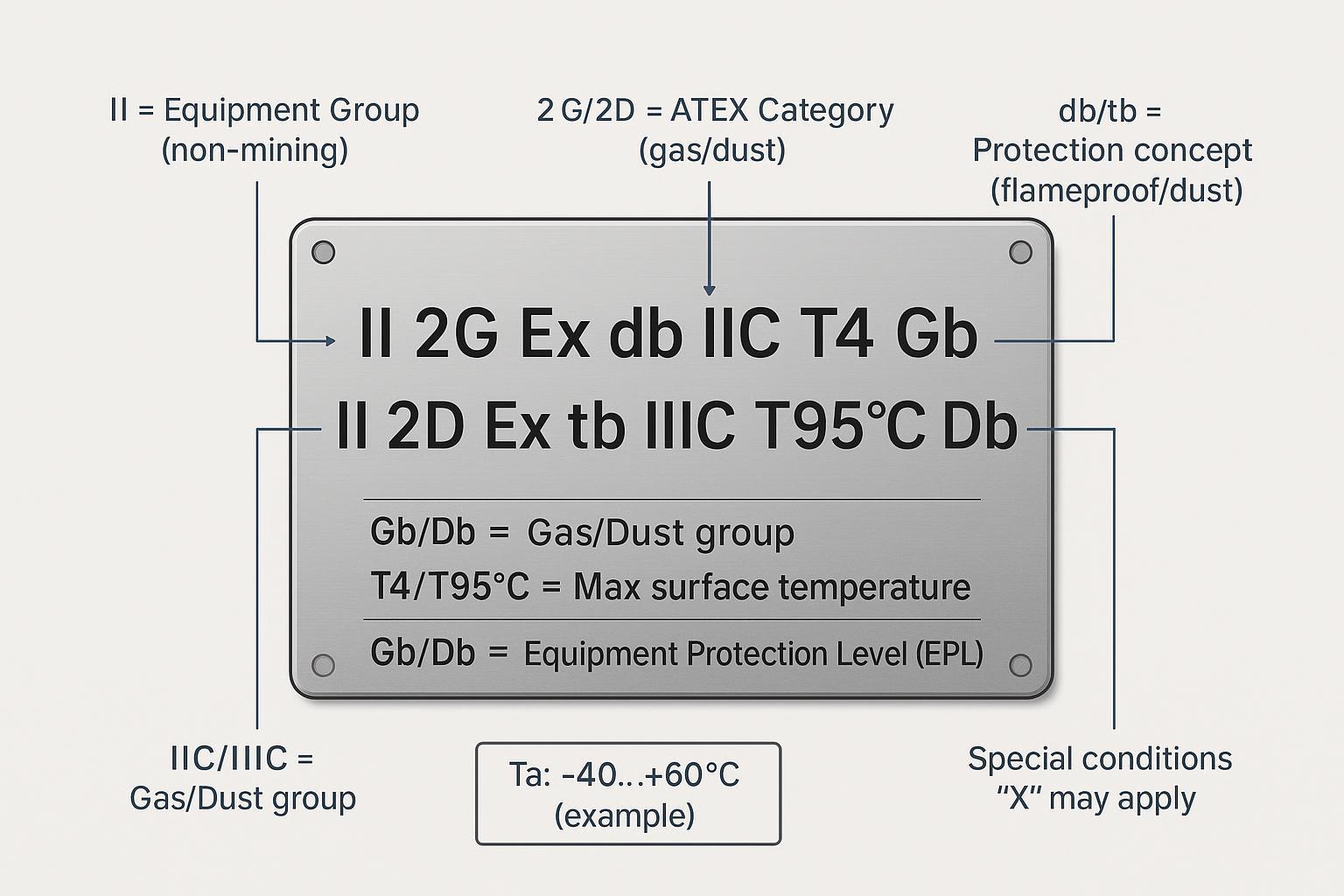
A typical PTZ with gas and dust certification may carry strings like “II 2G Ex db IIC T4 Gb” and “II 2D Ex tb IIIC T95°C Db.” Decoding this correctly is the fastest way to confirm zone suitability, group coverage, temperature class, and EPL before you even open a datasheet.
Disclosure: ZAEX is our product. For a neutral walk-through of enclosure ratings and markings context, the ZAEX site has an explainer that discusses IP ratings and shows sample plate imagery; it’s a useful pattern for what to expect on a manufacturer article: ZAEX IP ratings and nameplate context explainer.
“II” = Equipment Group for non-mining industrial environments.
“2G/2D” = ATEX Category (gas/dust); together with EPL, it maps to Zones (Zone 1→Gb/2G; Zone 2→Gc/3G). See the European Commission’s ATEX equipment page for how equipment categories fit into the directive framework.
“Ex d” (db) / “Ex t” (tb) = Protection concepts (flameproof enclosure; dust protection by enclosure).
“IIC/IIIC” = Gas/Dust group; IIC and IIIC are the most stringent within their groups.
“T4” or “T95°C” = Maximum external surface temperature under the certified conditions.
“Gb/Db” = Equipment Protection Level; higher letters (Ga/Da) indicate stricter levels.
“Ta: -40…+60°C (example)” = Ambient range over which the above ratings hold; it is part of the certificate conditions.
Nameplate decoding should be cross-checked against the certificate or the official listing to confirm any “X” special conditions and to verify the exact Ta limits. Verify via the official IECEx equipment certificate search and, for ATEX, look up the issuing body via the EU’s NANDO Notified Bodies directory for 2014/34/EU and then consult that body’s database for the certificate.
Decision tree — choose the right zone rating for your PTZ
Ask first: Is an explosive gas atmosphere likely during normal operation?
Yes → Select Zone 1 (EPL Gb) PTZ.
No → Is an explosive atmosphere possible only during abnormal conditions, and brief? If yes → Zone 2 (EPL Gc) may be suitable.
Then validate specifics:
Gas/dust group: IIA/IIB/IIC (gas), IIIA/IIIB/IIIC (dust) against your substances list.
Temperature class: ensure the T-class stays below the lowest AIT present, considering the certified Ta.
Installation concept: confirm allowed protection type(s) and corresponding cable glands, sealing, and earthing per IEC/EN 60079-14.
Auditor’s pre-spec checklist (condensed):
Zone/EPL/Category mapping confirmed against the site’s area classification dossier—definitions summarized well in the UK regulator’s hazardous area classification overview.
Gas/dust group and T-class vs AIT table verified; Ta range matches site extremes.
Certificate “X” conditions known; appropriate glands and accessories available.
Maintenance/inspection plan per IEC/EN 60079-17 prepared for the environment (corrosive, dusty, deluge).
Installation and maintenance items auditors check (IEC/EN 60079-14/-17)
Cable entries and glands: The gland’s protection concept must match the enclosure; boundary seals and restricted-breathing requirements apply as per the protection type. Poor gland selection is a frequent audit finding.
Enclosure integrity: Don’t drill new holes without OEM guidance; preserve flamepaths and torque values. PTZ windows, wipers, and junction boxes must maintain the IP rating stated on the certificate.
Earthing/bonding: Verify continuity from the PTZ housing to structure; control static buildup in rotating assemblies.
Competence and records: Initial inspection and periodic inspections are mandatory; intervals shorten in corrosive or heavy-spray environments. Keep certificate copies, schedules of limitations, and inspection checklists accessible.
Here’s the deal: even the best-specified PTZ fails compliance if a single non-certified gland or an over-torqued cover damages a flamepath.
Crosswalk: ATEX/IECEx vs NEC/CEC Class/Division (what maps, what doesn’t)
The systems are not one-to-one, but common approximations guide global deployments. A widely cited industry explainer outlines the relationship and cautions on non-equivalence; use it to orient stakeholders, then validate EPL/Category locally: see UL’s hazardous locations overview (Class/Division vs Zones).
Class I, Division 1 ≈ Zones 0/1 for gases/vapors.
Class I, Division 2 ≈ Zone 2.
Class II/III, Division 1 ≈ Zones 20/21 for dusts.
Class II/III, Division 2 ≈ Zone 22.
When cross-accepting equipment, confirm the EPL/Category and the specific certificate details rather than relying only on an approximation chart. Always align with the local Authority Having Jurisdiction (AHJ).
FAQs
Q1: Which PTZ should I use for ATEX Zone 1 vs Zone 2?
A: Use Zone 1 (EPL Gb) where explosive atmospheres are likely in normal operation; Zone 2 (EPL Gc) where presence is unlikely and brief. Then confirm gas/dust group, T-class vs AIT, and Ta. Definitions of the zones are summarized in the UK regulator’s hazardous area classification overview.
Q2: Can I install a Zone 1 camera in a Zone 2 area?
A: Generally yes, provided all certificate conditions—ambient range, sealing, and any special “X” conditions—are met. The reverse is not allowed. The UK regulator’s ATEX equipment guidance explains the principle.
Q3: How do I read “Ex d IIC T6 Gb” on a nameplate?
A: Ex d = flameproof enclosure; IIC = most stringent gas group; T6 = max surface temp 85°C; Gb = EPL suitable for Zone 1. Always compare the T-class to your lowest AIT and verify the Ta range; confirm via the IECEx certificate search.
Q4: What about dust hazards—do gas Zone ratings cover them?
A: Not automatically. You need the dust line (e.g., “Ex tb IIIC T95°C Db”). Select dual-rated equipment if both gas and dust hazards exist, and check the dust Tmax and group. The European Commission’s ATEX equipment page explains equipment categories across gas and dust.
Q5: Do ambient extremes change the T-class?
A: They can. Many devices achieve a tighter T-class only within a specified Ta. Beyond that, the achievable T-class may relax. See a concise example in Pepperl+Fuchs’ Ta–T-class guidance and always check your device’s certificate schedule.
Appendix: Verify certificates and documentation
Find the certificate: Use the official IECEx equipment search to locate the certificate and schedule of limitations. For ATEX, confirm the Notified Body via the EU NANDO directory for 2014/34/EU, then search the specific body’s database for the certificate number.
Confirm the zone mapping: Map Zone 1 to EPL Gb/Category 2G and Zone 2 to EPL Gc/Category 3G; verify this on the product’s certificate and nameplate. The UK regulator’s hazardous area classification overview provides the definitions used by many area classification studies.
Validate group and temperature: Compare IIA/IIB/IIC and the stated T-class—or dust Tmax—against your substances’ AIT data. Ensure the Ta range covers seasonal extremes and internal heating loads.
Record keeping: Store certificate PDFs, “X” conditions, installation manuals, and inspection records for audits. A single missing “schedule of limitations” can stall commissioning.
Notes and sources for further reading (selected):
UK regulator’s definitions and zone mapping: Hazardous area classification and ATEX equipment and explosive atmospheres (accessed 2026).
European Commission summary of ATEX equipment under the directive: ATEX equipment – European Commission (accessed 2026).
Ambient range vs achievable T-class examples: Pepperl+Fuchs application note (manufacturer technical note).
Class/Division vs Zone orientation: UL hazardous locations overview (overview PDF).
Certificate verification: IECEx official search portal; NANDO Notified Bodies for 2014/34/EU.
Standards and local codes are subject to change. Always verify the latest editions with your AHJ and notified bodies before specification and installation.