


ATEX vs IECEx: Which Certification Matters for Explosion Proof Cameras in Oil and Gas?
ATEX applies to equipment placed on the EU market, IECEx serves projects outside that framework, and the choice depends on where the cameras will be installed. This comparison sets out how both certification systems work and how to match them to a target market.
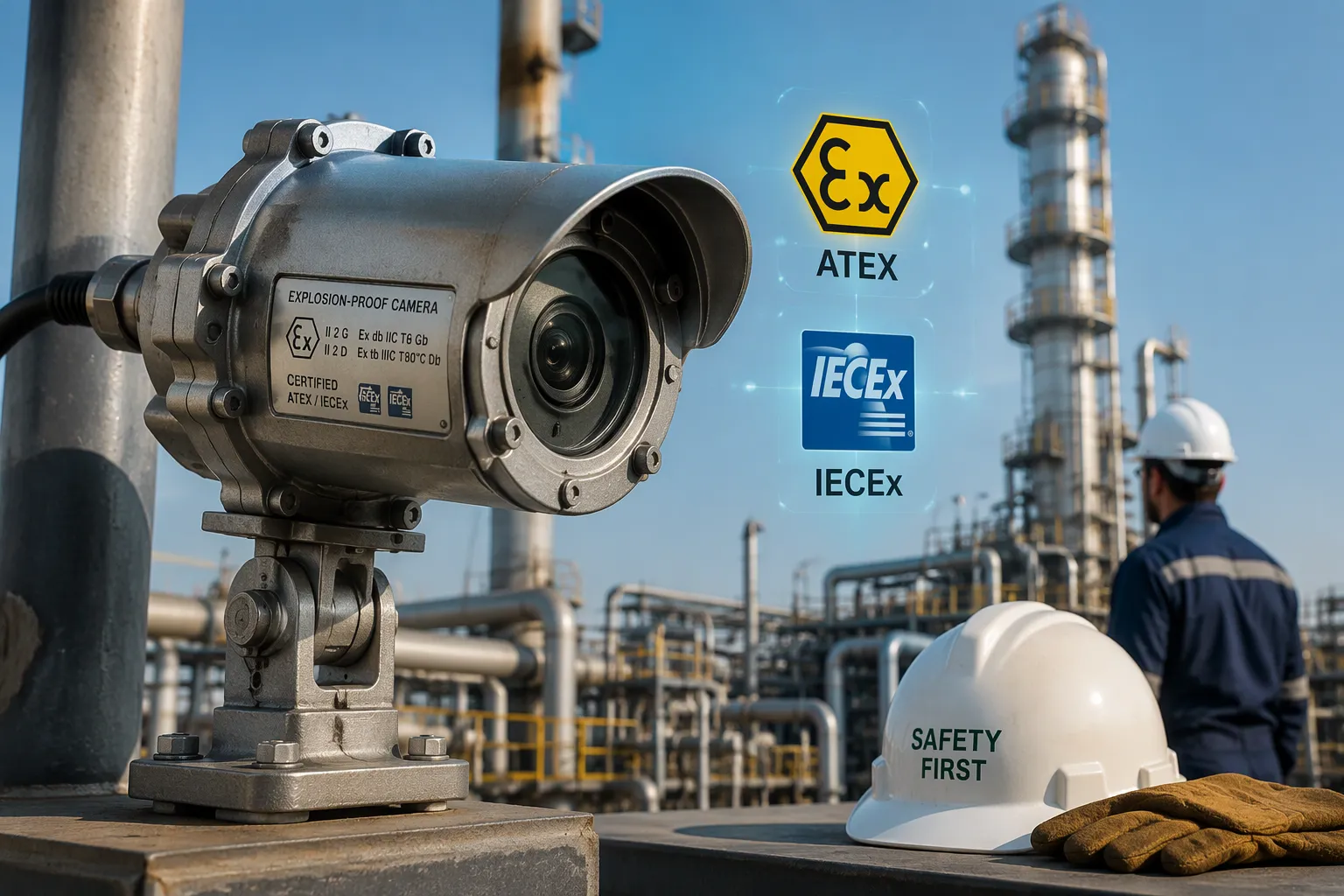
Certification matters because an explosion proof camera for oil and gas does two jobs. It gives operators a continuous view of equipment and people, and it does not become an ignition source. Certified equipment protects lives, supports incident investigation, and meets the legal duties that govern hazardous areas. Many facilities must install certified equipment to satisfy occupational health and safety rules.
This comparison explains how both systems work and how to match certification and compliance to the target markets.
Key Takeaways
ATEX is legally required for cameras placed on the EU market, as the complete ATEX camera guide explains.
IECEx is an international certification that many countries recognize.
Choose certification based on where the camera will be installed, guided by ATEX versus NEC 505 camera classifications for North American work.
Dual certification (ATEX and IECEx) simplifies compliance for global projects.
Match the certificate to the exact camera model and accessories.
Check that the certificate covers the correct zone, gas group, and temperature class.
Plan certification early in the design process to avoid costly redesigns.
Keep compliance records for the life of the facility and follow inspection schedules.
What Is ATEX Certification?
Definition and Scope
ATEX certification is the European Union's legal framework for equipment used in explosive atmospheres. The name comes from the French "Explosive Atmospheres." Two directives make up the system, and the equipment directive governs cameras and other electrical devices. An introduction to what an ATEX camera is and where it is used covers the equipment side of that framework.
EU Directive 2014/34/EU
Directive 2014/34/EU sets the essential health and safety requirements and conformity assessment procedures that apply before a product reaches the EU market. The directive aims to allow free trade of ATEX equipment within the EU by removing the need for separate testing and documentation in each member state. Manufacturers who apply its provisions and affix the CE marking and the Ex marking can sell their equipment anywhere in the European Union without further requirements for the covered risks.
The directive defines two equipment groups, not two categories. The full text of Directive 2014/34/EU assigns Group I to underground mines and their surface installations exposed to firedamp or combustible dust, and Group II to every other place with a potentially explosive atmosphere. Group I divides into categories M1 and M2; Group II divides into categories 1, 2, and 3. The category, not the group label, governs which zone a camera may be installed in. It covers a broad product range, including equipment for fixed offshore platforms, petrochemical plants, and other sites where a potentially explosive atmosphere may exist. Article 1 sets out three kinds of products in scope:
Equipment and protective systems used in potentially explosive atmospheres
Safety, controlling, and regulating devices needed for the safe functioning of that equipment
Components essential to safe functioning but with no autonomous function
Where ATEX Is Required
ATEX requirements apply in all EU member states, and the regulation also shapes rules in countries that align with EU law. Three conditions bring equipment within the directive: the equipment has its own effective source of ignition, it is intended for use in a potentially explosive atmosphere of air mixtures, and it operates under normal atmospheric conditions. A camera with electronics and a power supply meets these conditions in a refinery or tank farm.
ATEX for Explosion Proof Cameras
Equipment Categories and Zones
Area classification follows the workplace Directive 1999/92/EC and the IEC 60079-10 series. It names Zone 0, 1, or 2 for gas and Zone 20, 21, or 22 for dust according to how often an explosive atmosphere is present. The equipment directive then assigns categories to those zones: Category 1G for Zone 0, 2G for Zone 1, and 3G for Zone 2. A camera certified for a higher-risk zone generally suits lower-risk zones as well, but the reverse does not hold.
Marking and Documentation
The marking on a camera tells the full story. Buyers should read the complete equipment marking and certificate for the exact configuration, including protection concept, gas group, temperature limits, and conditions of use. An X suffix in the certificate identifies special conditions that the installer must meet. Certification also applies to the whole assembly, not just the housing. An unapproved gland, cable, or modification can void ATEX compliance and leave the installation non-compliant with applicable standards. Buyers should confirm that the certificate covers every supplied item and accessory before relying on the marking.
Need a Certified Camera for a Classified Area?
Share the zone, gas group, temperature class and target market to get a specification that matches the site classification drawing.
What Is IECEx Certification?
Definition and Scope
The IECEx System
IECEx certification is an international system that aims to simplify the approval process for electrical and non-electrical equipment used in explosive atmospheres. The IECEx system operated by the International Electrotechnical Commission exists so that products comply with international standards, reducing barriers to trade while maintaining safety measures. The scheme serves two audiences: manufacturers who need one test program and buyers who need confidence in a product's safety. A companion article on ATEX CCTV cameras in hazardous environments sets out the equipment context on the European side.
The system lets manufacturers demonstrate third-party conformity assessment to recognized international standards. A number of international markets accept an IECEx Certificate of Conformity for market access directly. Other markets accept the certificate as proof that the product complies with international standards and supports local approval. That flexibility explains why the scheme appears on many oil and gas specifications.
Where IECEx Is Recognized
IECEx supports manufacturers who seek broader international market access. ATEX governs placement of equipment on the European market. Both frameworks address equipment for potentially explosive atmospheres, yet they operate within different regulatory and geographic scopes. One is a legal duty inside the EU; the other is a voluntary international route.
Oil and gas projects often name the scheme for international work. Published specifications list it alongside FM for the US and Canada, ATEX for the EU, INMETRO for Brazil, and PESO for India. Buyers should check that certificate numbers match the model being quoted, because a certificate for one camera does not cover a similar model from the same range.
IECEx for Explosion Proof Cameras
Standards and Technical Requirements
A camera for a refinery must match its certification to the area classification. The area classification drawing determines the specific scheme, and the answer varies by location within the refinery. Typical refinery process areas call for Class I Division 1 Group D equipment in the USA or ATEX Zone 1 IIA/IIB internationally. Hydrogen service in hydroprocessing units calls for Group B or IIC equipment.
| Requirement | Detail |
|---|---|
| Schemes | ATEX, IECEx, and UL listed options |
| Area classification matching | Match the certificate to Zone 0/1/2 or Class I Division 1/2 |
| Typical refinery process areas | Class I Division 1 Group D (USA) or ATEX Zone 1 IIA/IIB (international) |
| Hydrogen service | Group B or IIC equipment |
Certificate and Marking
The IECEx requirements center on third-party testing and certification that names the exact product. Buyers should verify that the certificate covers the camera model, the housing, and every accessory in the quotation. An unapproved gland or cable entry can undermine compliance and leave the installation non-compliant with the site's safety case.
Suppliers typically ask for zone classification, application details, and coverage requirements before issuing a technical quote. That information also helps confirm which applicable standards the certificate references. A review of the certificate before purchase saves rework at commissioning.
ATEX vs IECEx: Key Differences
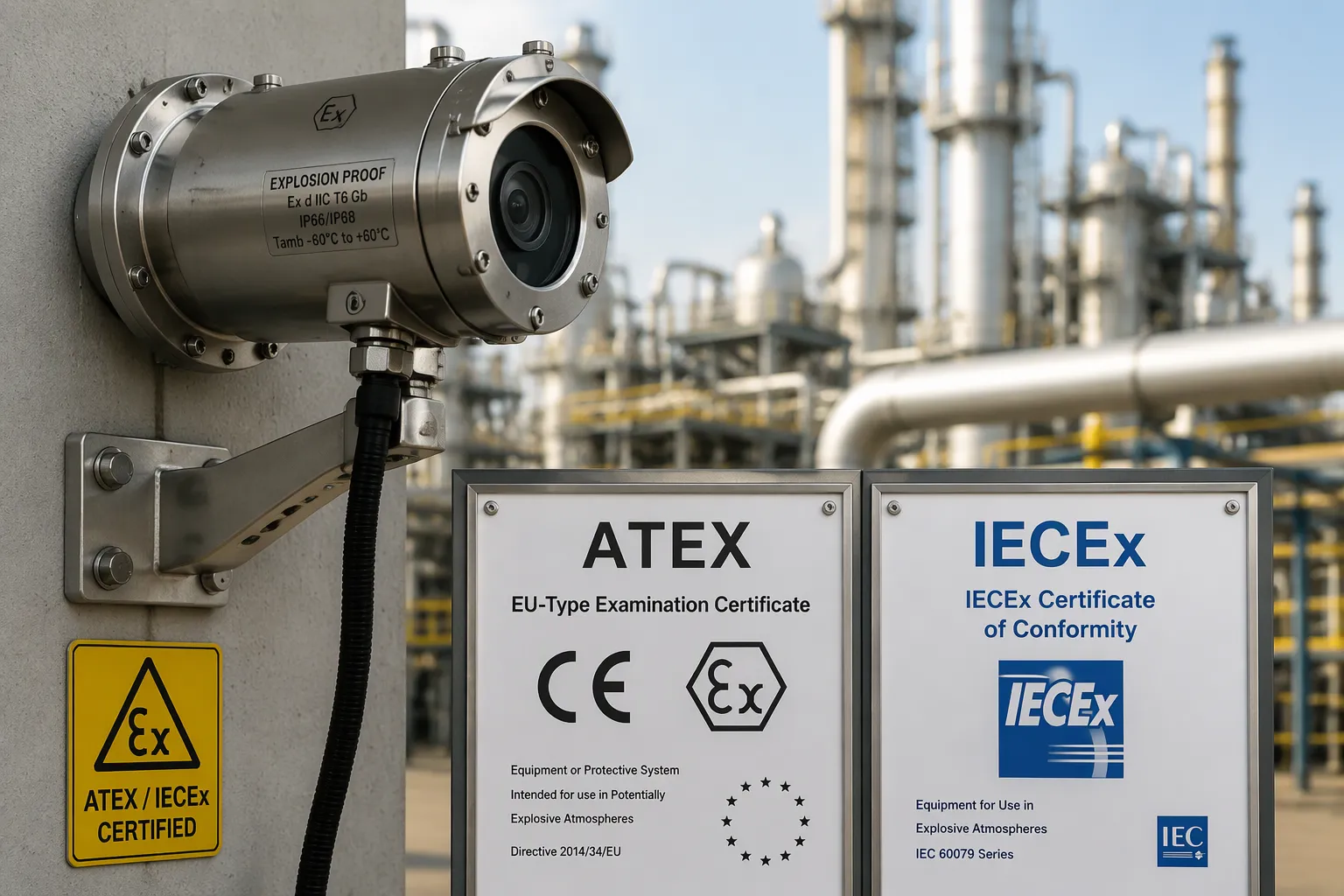
The two systems pursue the same safety goal. They differ in legal weight, geographic reach, and procedure. A structured comparison helps buyers read a certificate with confidence and choose the right certification pathway for each project.
Comparison Table
Region, Mandatory Status, Standards, Process
| Feature | ATEX | IECEx |
|---|---|---|
| Region | European Union and EEA; the UK market uses UKCA with similar requirements | Recognized internationally, including Australia, South Africa, UAE, Canada, and Brazil |
| Mandatory status | Legally required in the EU under Directive 2014/34/EU | Voluntary in most regions and mandatory in some countries; the technical basis for many national approvals |
| Standards | EN standards, aligned with IEC but with possible differences | IEC 60079 series |
| Certification process | Self-declaration for Category 3; Notified Body assessment for Categories 1 and 2; Declaration of Conformity plus CE and Ex marking | Third-party testing by an ExTL, review by an ExCB, Certificate of Conformity and test report published in the public database |
One is a mandatory EU directive, the other a voluntary international scheme. The table also explains why atex vs iecex vs nec questions surface in global projects, since North American rules sit outside both systems; ATEX versus NEC 505 camera classifications covers that third framework. Two qualifications apply to the process row: Category 2 electrical equipment requires an EU-type examination by a Notified Body, while some non-electrical Category 2 equipment may follow internal production control with the technical file lodged with a body; and the zone labels come from the workplace directive while the category numbers come from the equipment directive.
Standards Overlap
How IEC and EN Standards Relate
Buyers who compare atex and iecex certification often find the technical content nearly identical. European Norm standards track the IEC 60079 series, and many carry a dual EN IEC label. Published comparisons list increased safety Ex e under EN IEC 60079-7, for example, and the same document covers the Ex eb and Ex ec variants. The shared numbering means a design built to IEC 60079 usually sits close to the European text.
Small differences remain. EU law treats the essential health and safety requirements as the legal benchmark and describes harmonised standards as giving a presumption of conformity, while the international scheme requires full compliance with IEC standards and allows no deviation. Edition dates matter as well. A certificate cites a specific edition of each applicable standards document, and an older edition may not satisfy a current project specification. Buyers should compare the edition printed on the certificate with the edition named in the tender.
Certification Process Differences
Notified Bodies vs IECEx Bodies
The two routes assign work to different organizations. EU member state governments designate Notified Bodies, and each body reports to its national authority. The international system uses a two-tier structure: Ex Testing Laboratories carry out testing and issue Ex Test Reports, and Ex Certification Bodies review those reports and the quality assessment report before issuing a Certificate of Conformity. Ex Certification Bodies are assessed against ISO/IEC 17065, while Ex Testing Laboratories work to ISO/IEC 17025.
Self-declaration marks a clear procedural gap. Category 3 equipment may self-declare under ATEX, and the manufacturer issues the EU Declaration of Conformity. The international scheme permits no self-certification; every product goes through third-party assessment. Category 1 and 2 equipment needs a Notified Body in Europe as well, so the gap narrows for the high-risk categories common in oil and gas.
Mutual recognition differs too. Accredited bodies must accept each other's test reports under the international system. Europe has no equivalent formal requirement between Notified Bodies. Cross-reliance is asymmetric: an ATEX assessment can draw on an IECEx Ex Test Report, while an IECEx certificate is not built from European paperwork alone. A manufacturer cannot build an international certificate from European paperwork alone; the ATEX camera guide sets out the documents the EU route requires.
These differences shape the certification requirements a project team writes into a purchase order. A European buyer needs the Declaration of Conformity and the CE marking with Ex coding. An international buyer needs a Certificate of Conformity published in the public database, plus the test report behind it. Both documents name the exact product, so the model on the certificate must match the model on the quotation.
Choosing by Target Market
Europe and ATEX Requirements
When ATEX Is Non-Negotiable
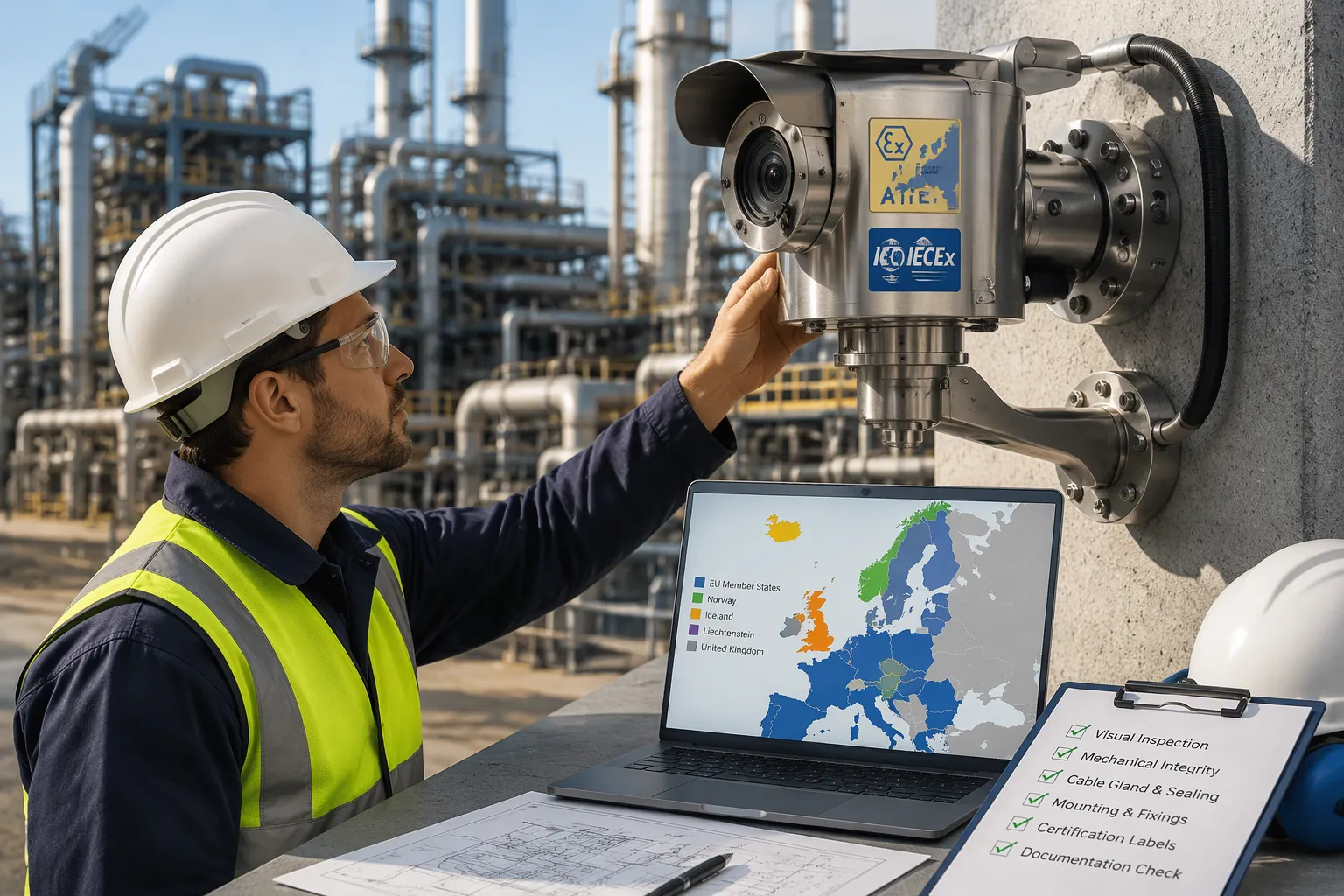
Installation location decides the certification pathway. A camera bound for a refinery in the Netherlands or a tank farm in Norway needs the European scheme before anything else. The framework is legally mandatory in the 27 EU member states, plus EEA members Norway, Iceland, and Liechtenstein. The UK keeps equivalent duties under its own post-Brexit framework.
Two directives shape the atex requirements a buyer must satisfy. Directive 2014/34/EU governs design, manufacture, and approval of the equipment itself. Directive 1999/92/EC governs the employer's duties: risk assessment, hazardous area classification, and use of appropriately approved equipment. Article 8 of the workplace directive requires an Explosion Protection Document before work begins in a classified area. That document lists the equipment register, the area drawings, and the inspection regime.
Camera selection follows the zone. Published guidance advises Group II, Category 2G for Zone 1 and Category 3G for Zone 2. Full-featured models commonly use Ex d flameproof enclosures, which allow AC or PoE+ power for motorized PTZ, IR illumination, and high-resolution imaging. Intrinsically safe designs exist, yet they stay power-limited to fixed, low-resolution units.
In oil and gas, chemical processing, and mining, combustible gases, vapours, and dust can be present. An ignition source from equipment that is not designed for the location can start an explosion.
Verification is straightforward. Certificates issued after a Notified Body assessment carry that body's four-digit identification number, which can be checked against the public register. Category 3 equipment carries no such number because no Notified Body took part in its assessment.
International IECEx Markets
Regions and Projects Favoring IECEx
Projects outside Europe often name the international scheme instead. Published approval lists name Australia, New Zealand, Brazil, Canada, China, Japan, South Korea, Malaysia, Singapore, South Africa, and the United States as markets where the scheme is recognized. Suppliers describe coverage across South America, Africa, Asia, and Australia with explosion proof PTZ cameras rated to the international system. Buyers should confirm the local rule before relying on any such list.
The iecex requirements rest on third-party testing and a Certificate of Conformity published in the public database. Buyers on international tenders should confirm that the certificate names the exact model, housing, and accessories in the quotation. A certificate for one camera does not extend to a similar model in the same range.
Dual and Regional Schemes
When Both Are Needed
Multinational operators rarely run one product line per continent. Dual-certified devices simplify regulatory compliance for oil and gas, marine, and energy companies with operations across continents. Large projects often specify dual-certified equipment to keep flexibility across global supply chains.
A dual atex and iecex certification package removes duplicate testing and audit friction. The atex vs iecex comparison then becomes a documentation question rather than a design question. One housing, one test program, and two sets of paperwork serve both markets.
Regional add-ons complete the picture: Brazil uses INMETRO, the UK uses UKCA, and India uses PESO. Buyers should treat these schemes as separate approvals, not automatic extensions of a European or international certificate.
Compliance records matter as much as the marking. Workplace regulations require documentation to be retained for the operating life of the facility and produced on request. Missing records count as a breach of the workplace regulations, whether or not an incident occurs. Published inspection guidance describes annual checks for Zone 1 and checks every one to three years for Zone 2, ranging from visual to detailed; the site's own inspection regime governs.
A practical rule closes the section. Match the certificate to the site drawing first, then to the purchase order. The drawing names the zone and the gas group. The purchase order names the model. When both align, the installation passes its initial inspection without rework.
Planning a Multi-Market Camera Order?
Compare certified housings, check the documentation set and read the classification guidance before the enclosure design is fixed.
Technical Factors for an Explosion Proof Camera for Oil and Gas
Hazardous Area Classification
Zones, Gas Groups, Temperature Classes
Every camera selection starts with the site's area classification drawing. That drawing names the zone, the gas group, and the temperature class for each location. A refinery pump pad, a tank farm vapor space, and a loading gantry each carry a different rating. IEC 60079-10-1 and the ATEX workplace directive classify gas areas as Zone 0, 1, and 2, while dust areas use Zone 20, 21, and 22.
| Factor | What It Defines |
|---|---|
| Zone | How often an explosive atmosphere occurs: continuous (Zone 0), likely (Zone 1), or brief (Zone 2) |
| Gas group | IIA (propane-like), IIB (ethylene-like), or IIC (hydrogen and acetylene) |
| Temperature class | Maximum surface temperature: T1 at 450 C down to T6 at 85 C |
The temperature class must stay below the autoignition temperature of the gas present. A T6 rating caps surface temperature at 85 C, which suits most hydrocarbon service. Hydrogen service pushes the gas group to IIC and tightens flame path tolerances. An accurate hazardous-location classification prevents the common error of fitting Zone 2 equipment in a Zone 1 area.
Protection Methods and Enclosure Design
Matching Design to Each Scheme
Flameproof enclosure, or Ex d, is a common choice for cameras in hazardous locations. The housing contains an internal explosion and cools escaping gases through narrow flame path joints. Published design notes describe Ex p (pressurized) as an exclusion strategy for large enclosures, and Ex e (increased safety) as unsuitable for active camera electronics. Intrinsically safe designs differ here: Ex ia limits circuit energy, yet a full-featured PTZ camera usually exceeds that budget. Explosion proof PTZ cameras for oil and gas illustrate the class of equipment that needs a flameproof housing instead.
Stainless steel 316L housings resist hydrogen sulfide corrosion in refineries and offshore platforms. The viewport forms part of the flame path boundary, so window material and seating carry their own certification. Cable glands must match the protection method; a standard gland on an Ex d housing voids the certification. Buyers should verify the certificate for the exact model, including its protection concept, gas group, temperature class, and certified accessories, rather than relying on a model-family description.
Explosion proof PTZ camera ranges group these housings by mounting style and payload. Two examples from the manufacturer's catalogue are shown below.
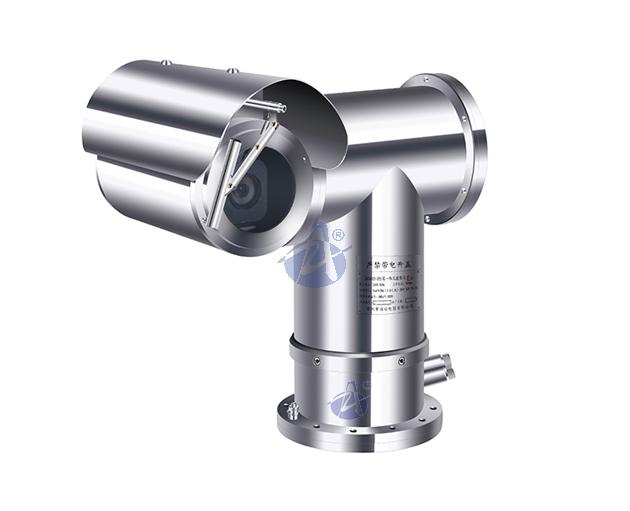
ZAT600 Explosion Proof PTZ Camera
A stainless steel PTZ camera housing offered for Zone 1 and Zone 21 hazardous areas in oil and gas service.
View Product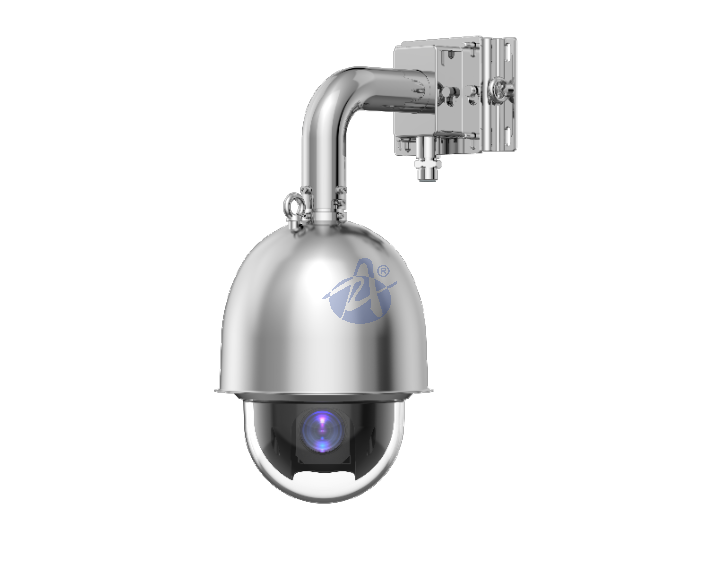
ATEX and IECEx Certified PTZ Speed Dome Camera
A 2MP, 33x optical zoom speed dome camera offered with ATEX and IECEx certification in a stainless steel housing.
View ProductTesting and Component Impact
Enclosure, Components, Testing
Certification rests on destructive and environmental testing. Published test descriptions list four core tests: an ignition test that repeatedly ignites a worst-case mixture inside the enclosure, an over-temperature test at maximum rating, an impact test aimed at the viewing window, and an ingress protection test where a single drop of water inside counts as failure.
Component choice decides whether a design passes. Drilling the housing, swapping cover bolts for non-equivalent hardware, or fitting a different camera model than the certificate names all void compliance. Buyers should confirm that the certificate covers the exact model, housing, and accessories. A 30x optical zoom PTZ with 100 m IR night vision only carries its rating when every supplied part matches the certificate.
Design and Certification Planning
Planning Certification Early
Aligning Design with Targets
Certification works well as a design input rather than a final inspection. Published guidance advises teams to consider certification during the early stages of product development. Early planning lets engineers evaluate target markets, applicable standards, hazardous-location requirements, product architecture, components and materials, testing requirements, and documentation needs. That list covers the decisions that are hardest to reverse later.
A camera designed for one market may need a different housing, cable entry, or circuit layout for another. Teams that lock the intended certification pathway before the enclosure drawing is fixed avoid redesign work at the prototype stage. They also give the notified body or ExCB a clean technical file to review.
Documentation and Testing Strategy
Technical Files and Test Plans
The technical file carries the certification. It holds the drawings, the bill of materials, the component certificates, the risk assessment, and the marking artwork. Each item must match the product as built. A mismatch between the drawing and the shipped unit is a common reason a review stalls.
Test planning follows the same logic. The ignition, over-temperature, impact, and ingress protection tests each need a representative sample and a defined worst-case configuration. Teams should book test slots against the prototype schedule, not after production starts. Building testing and documentation requirements into the project plan keeps the certification pathway on the critical path where it belongs.
Cost and Timeline
Single vs Dual Certification
A single scheme costs less up front. One test program, one technical file, and one review cycle serve one market. Dual atex and iecex certification adds review effort and paperwork, yet it often costs less than running two separate programs later. Why explosion proof PTZ cameras matter in oil, gas, and chemical plants sets out the operating demands behind that choice. The shared IEC 60079 technical basis means one test report can support both certificates.
Timeline pressure usually decides the question. A project that needs European market access first should sequence atex approval ahead of any international filing. A project serving global tenders should plan both from the start. Either way, the certification requirements belong in the budget and schedule before engineering begins, not after the first unit ships.
ATEX vs IECEx vs NEC: Other Markets
NEC and North American Requirements
Class/Division vs Zone Systems
North America runs its own rulebook. The National Electrical Code, or NEC, governs installations in the United States, and it does not recognize ATEX or IECEx markings on their own. US regulations for hazardous classified locations require equipment to be approved for the class and division of the location; a Division 1 location calls for a UL or FM listing under NEC Article 500. A camera carrying only a European mark cannot substitute for that listing.
The two systems describe hazard differently. The Division method splits gas areas into Division 1 and Division 2, and it groups gases as A, B, C, and D. The Zone method uses Zone 0, 1, and 2 with gas groups IIA, IIB, and IIC. Published crosswalks map Zone 1 to Class I Division 1 and Zone 2 to Class I Division 2, with IEC Group IIC covering NEC Groups A through D as a general comparison. The mapping is approximate: Division 1 spans both Zone 0 and Zone 1, so a conversion needs to be documented. NEC Article 505 was added to NFPA 70 to accept the zone system as an alternative, provided the authority having jurisdiction accepts the certificate; ATEX versus NEC 505 camera classifications sets out the US code side in more detail.
Does One Certification Cover All?
Limits of ATEX and IECEx
No single scheme opens every market. ATEX-certified cameras cannot be used in the United States without additional U.S. certification, because NEC and OSHA require listing by a nationally recognized testing laboratory. The reverse also holds: NEC-listed equipment cannot enter EU markets without ATEX approval, even when the technical equivalence is obvious.
IECEx certification travels further, yet it still stops at the U.S. border under Article 500. Buyers should treat each scheme as a regional key, not a master key. The limits of ATEX and IECEx become clear at the border, and the fix is a second listing rather than a legal argument.
Multi-Market Certification Strategy
Combining Schemes for Global Reach
A dual or triple listing solves the problem. Dual-certified products carrying both ATEX/IECEx and UL/cUL markings reduce the interchangeability problem. Differences in standards across regions add complexity and raise time-to-market and cost, so manufacturers tailor products for each market.
Planning starts with the area classification drawing for every site in scope. That drawing defines the hazardous-location requirements, and it should drive the intended certification pathway before the enclosure design is fixed. A project spanning Europe, the Middle East, and Texas needs three approvals on one housing. Teams that map the target markets early avoid a second test program later, and they keep the certification pathway short.
Site location decides the certification pathway. ATEX satisfies European legal duties, while IECEx opens international markets and supports many national approvals. Neither scheme is superior; each fits a defined scope. Projects that span regions often gain from dual approval, which removes duplicate testing and keeps one housing valid across markets.
Buyers can review the manufacturer's explosion proof camera range for models carrying both marks. The final step is to match the certificate to the site drawing and the target market before the purchase order is issued; that check keeps compliance intact from commissioning onward.
Ready to Specify the Certificate and the Camera Together?
Browse the certified product range, compare camera types and read further industry guides before issuing the purchase order.
FAQ
Which certificate does a European refinery project require?
ATEX is the legal requirement for equipment placed on the EU market under Directive 2014/34/EU. A camera installed in a Dutch refinery or a Norwegian tank farm needs the CE and Ex marking plus an EU Declaration of Conformity. IECEx alone does not satisfy that duty.
Can an ATEX-certified camera be installed in the United States?
No. The NEC does not recognize ATEX or IECEx markings on their own. A Division 1 location requires a listing from a nationally recognized testing laboratory, such as UL or FM, under NEC Article 500. Buyers need a separate North American approval.
When should a project specify both ATEX and IECEx?
Dual certification suits operators with sites in several regions. One housing and one test program then serve both markets, which removes duplicate testing and audit work. Teams should fix the intended certification pathway before the enclosure design is frozen.
What should a buyer check on an explosion proof camera for oil and gas certificate?
Check that the certificate names the exact model, housing, and accessories in the quotation. Confirm the zone, gas group, and temperature class match the site drawing. An X suffix signals special conditions the installer must meet. An unapproved gland can void compliance.
How do Zone and Division systems compare?
Zone 1 is commonly mapped to Class I Division 1, and Zone 2 to Class I Division 2, but the correspondence is approximate because Division 1 also covers Zone 0 conditions. Gas group IIC covers NEC Groups A through D as a general comparison. NEC Article 505 accepts the zone method when the authority having jurisdiction accepts the certificate.
Why does temperature class matter for camera selection?
The temperature class caps the surface temperature of the enclosure. T6 limits it to 85 C, which stays below the autoignition point of most hydrocarbon gases. Hydrogen service also pushes the gas group to IIC and tightens flame path tolerances.
Does IECEx certification replace local national approvals?
Not in every market. Some countries accept an IECEx Certificate of Conformity directly for market access. Others treat it as technical evidence that supports a local approval, such as INMETRO in Brazil or PESO in India. Buyers should confirm the local rule first.
How long must a facility keep compliance records?
Records must remain available for the operating life of the facility and be produced on request. Missing records count as a breach of workplace regulations, whether or not an incident occurs. Inspection intervals follow the zone, with annual checks typical for Zone 1.
Next reading: more explosion proof camera industry guides.
References and Notes
European Commission guidance on ATEX equipment — the essential health and safety requirements and conformity assessment duties under Directive 2014/34/EU (single-market-economy.ec.europa.eu, accessed 2026-11-10)
Full text of the ATEX equipment directive — equipment groups I and II, categories M1/M2 and 1/2/3, and the scope of Article 1 (eur-lex.europa.eu, accessed 2026-11-10). The workplace Directive 1999/92/EC, including Article 8 on the Explosion Protection Document, is published in the same EUR-Lex collection.
The IECEx system overview — the IEC scheme, its ExCB and ExTL structure, and its publicly searchable certificates (iecex.com, accessed 2026-11-10). ExCBs are assessed against ISO/IEC 17065 and ExTLs work to ISO/IEC 17025.
US rules for hazardous classified locations — the North American requirement that equipment be approved for the class and division where it is installed (osha.gov, accessed 2026-11-10)
Data notes: the three tables are reproduced from the original article and represent published comparison values, not certificate limits; the conformity assessment row is a summary, since Category 2 electrical equipment requires an EU-type examination while some non-electrical Category 2 equipment follows internal production control. The Zone to Division mapping is an approximate crosswalk, not a legal equivalence, because Division 1 covers both Zone 0 and Zone 1. The figure of 27 EU member states plus Norway, Iceland and Liechtenstein reflects the current EEA composition. Temperature class values (T1 at 450 C down to T6 at 85 C), inspection intervals and the list of countries recognizing IECEx are published guidance or supplier-reported figures and should be checked against the certificate and the local rule. Unverifiable items were removed: a supplier certificate number, a claim of coverage in over 50 countries, two Notified Body number examples that did not match the named bodies, and market-report commentary.
Internal links: all original links pointing to en.zaex.com.cn are preserved in full; product cards, a category link and a related-reading link were added. Links to competing suppliers, certification consultancies, industry blogs and market-report sites in the original article were removed while the underlying factual statements were retained in neutral wording.